




Exploring the Essential Features of “Benjamin White – Neuroplasticity and Stroke Rehab: A Roadmap to Functional Recovery
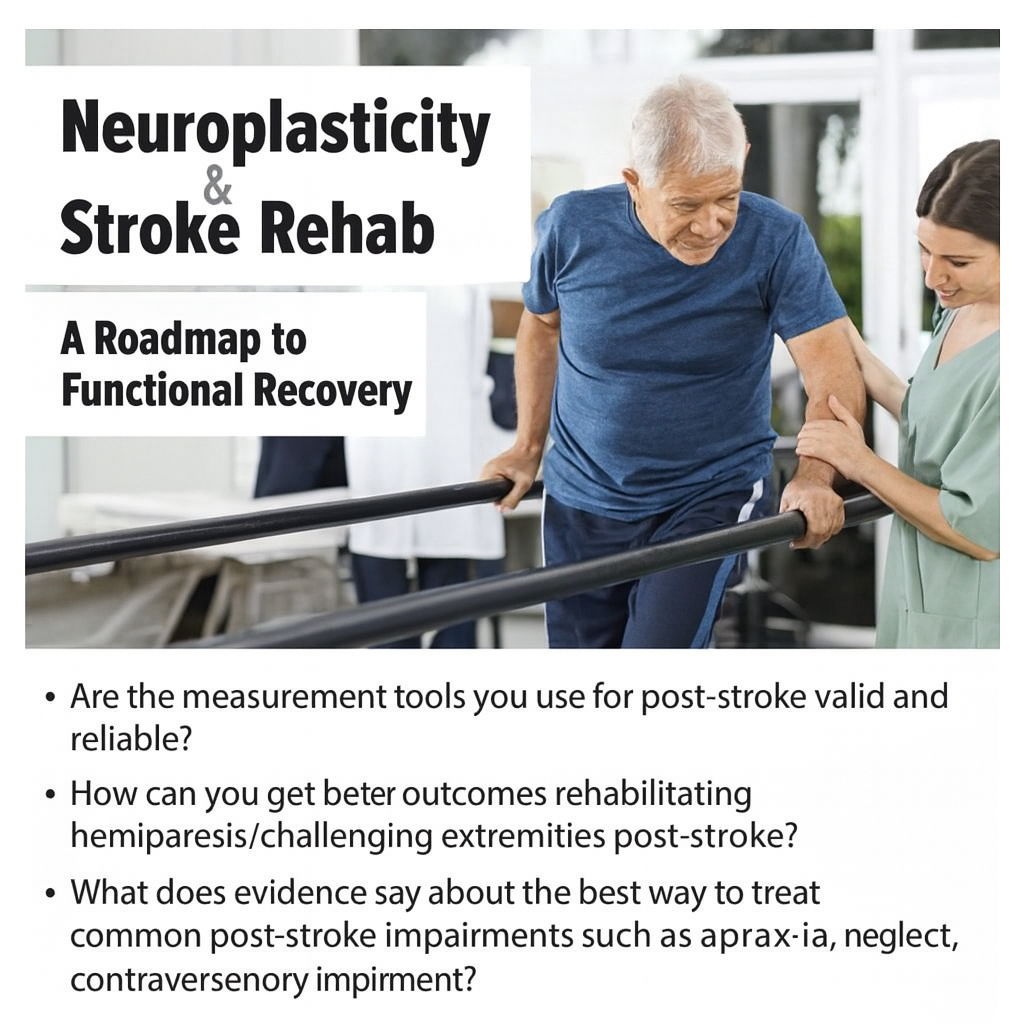
Neuroplasticity and Stroke Rehab: A Roadmap to Functional Recovery
Speaker: Benjamin White, PT, DPT, MBA, C/NDT, LSVT BIG
Duration: 5 Hours 31 Minutes
Format: Audio and Video
Description
Rewiring the Brain for Better Recovery
More and more, people are coming through our doors for treatment post-stroke. However, we find ourselves torn between promoting “recovery” and the reality of ever-decreasing rehab length of stays, which force us to focus on function alone. This pressure can cause us to resort to quick fixes or shortcuts that may help in the short-term, but may not have proper evidence for long-term recovery. Stroke rehab is not a quick fix. The fact is that we are increasingly pressured to provide evidence that our interventions are working (can someone say G Codes!). The critical necessity for rehabilitation professionals to act decisively, responsibly, and effectively with this growing population cannot be overstated.
Get the roadmap to stroke rehab that actually leads to recovery in this impactful course. Discuss common impairments seen in stroke (e.g., apraxia, neglect, pusher syndrome) and the interventions based on current principles of neuroplasticity to treat these impairments. Evidence-based treatments of the hemiparetic/hemiplegic upper and lower extremities after stroke will be covered as well. By the end of the course, you will walk away with the tools and resources needed to effectively improve outcomes for your stroke patients.
Speaker
Benjamin White, PT, DPT, MBA, C/NDT, LSVT BIG
Benjamin White, PT, DPT, MBA, C/NDT, LSVT BIG, is an expert in stroke rehabilitation who serves as the lead neurological therapist at a not-for-profit healthcare institution in Texas. A graduate of the University of Texas Health Science Center’s physical therapy program, he has treated a wide array of neurological diagnoses over the years, from concussions and vestibular disorders to stroke, Parkinson’s, and Guillain-Barre syndrome.
Dr. White is an award-winning clinical instructor, a renowned national speaker on stroke rehabilitation topics, and has published numerous articles on the topics of neuroplasticity and stroke. In addition, he serves on the Neuro-Development Treatment (NDT) publication committee and is the co-president of the Brazos Valley Parkinson’s Association.
Speaker Disclosures:
Financial: Benjamin White maintains a private practice and has employment relationships with the University of Texas and Common Spirit Healthcare. He receives a speaking honorarium and recording royalties from P.ebooksfit.online ESI, Inc. He has no relevant financial relationships with ineligible organizations.
Non-financial: Benjamin White has no relevant non-financial relationships.
Objectives
- Recall basic concepts of motor control as they apply to persons with stroke
- Apply basic principles of motor learning to persons with stroke
- List the causes and evidence-based treatments for some common impairments in stroke
- Recognize some of the commonly used outcome measures in stroke rehabilitation
- Determine the basic features of gait after stroke, as well as bracing options and a defined treatment protocol for gait recovery after stroke
- List evidence-based approaches for treatment of all extremities after stroke, including determining prognosis for recovery
- Analyze differences between various forms of weakness involving force production, timing, and sustainability
Outline
MOTOR LEARNING AND NEUROPLASTICITY
- Defined
- Various motor learning phases in the rehab process
COMMON STROKE RELATED IMPAIRMENTS WITH SPECIFIC TREATMENT METHODS
- Ataxia
- Hemiparesis
- Neglect
- Pusher Syndrome
- Subluxation
- Decreased Sensation
OUTCOME MEASURES
- Progress measures with the use of G-coding
- Acute stroke
- Chronic stroke
- Continuum of care
STRENGTH RECOVERY AFTER STROKE
- Forms of strength
- Force production
- Timing
- Sustainability
- Eccentric vs Concentric
- Kinetic chains
- Open
- Closed
- Modified closed
- When to use each
TACKLING OF UPPER AND LOWER EXTREMITY PARESES (CASE STUDY ICON)
- Upper extremity
- Lower extremity
- Four limbs simultaneously
- How
- Why
- Constraint-induced movement therapy
- Bimanual vs unimanual training
CLINICAL REASONING
- Power of salience
- Thinking beyond sets of ten
- Constraint-induced movement therapy
FITT PRINCIPLE
CLINCIAL REASONING (CASE STUDY ICON)
SUMMARIZATION AND SYNCHRONIZATION
Target Audience
- Physical Therapists
- Physical Therapist Assistants
- Occupational Therapists
- Occupational Therapy Assistants
- Exercise Physiologists
Reviews
There are no reviews yet.